- Basement Wall Sealing
- Nov 18, 2026
- 6 min read
A Columbus basement should stay below 60% relative humidity, and ideally between 30% and 50%. That is the EPA’s guidance for any indoor space, and basements are where it is hardest to meet, because the air is cooler and the walls touch damp soil. This guide covers how to measure it, why summer is the problem season here, and what to do when the number stays too high.
What humidity level should a Columbus basement stay under?
Keep a basement below 60% relative humidity, and aim for 30% to 50%. The EPA advises keeping indoor humidity below 60%, ideally between 30 and 50%, to help prevent mold growth on furnishings, clothing, and other items.
The 50% line matters for a second reason. The North Carolina Department of Health says to keep relative humidity below 60% to control mold and below 50% to control dust mites, at all times, including hours when nobody is home. Treat 60% as the ceiling you never want to cross and 50% as the number to work toward.
Season changes the target a little. One home-inspection source says summer basement humidity should be under 60% and winter humidity between about 20% and 40%, with regional variation. In winter the main reason to go lower is condensation on cold surfaces, so if you see beads of water on pipes or glass, set the target lower until they stop.
Why is Columbus basement air so damp in summer?
Columbus has a humid continental climate with hot, humid summers and no dry season. NOAA 1961 to 1990 normals, as summarized for Columbus, put the average relative humidity at about 69.5% across the year, with monthly averages ranging from about 62.5% in April to about 74.1% in December. Those are outdoor readings averaged over the day. They show that outside air rarely helps a basement dry out.
Summer brings the real moisture load. The average July dew point in the same data is 62.8°F, and August is 61.7°F. Weatherspark counts about 15 muggy days in July and about 13 in August, where muggy means a dew point above 65°F. Summer 2025 was unusually damp: Ohio University reported that Columbus averaged a dew point about 6.2°F above normal over June and July.
Why does that reach the basement? Warm, moist air drifts in through doors and windows, meets cooler concrete walls and cold-water pipes, and cools. Cooler air holds less moisture, so the excess condenses on those surfaces. That is why a basement can read well above the floors upstairs in July.
How do you measure basement humidity accurately?
Use a digital hygrometer and read it in the basement, not on the first floor. Hygrometers are inexpensive, and two sources put them at roughly $10 to $30. The University of Georgia Extension notes you can measure relative humidity with an inexpensive meter sold at hardware stores.
- Place it at breathing height in the middle of the room, away from the dehumidifier and vents
- Read it at the same time each day for two weeks, and in the morning and evening during a humid spell
- Add a second meter near a wall that feels damp or smells musty
- Choose a model that records highs and lows, so you see overnight swings
Do not trust one reading blindly. North Dakota State University Extension warns that hygrometers are often not accurate. Check yours by putting it beside a second meter for a day. If the two differ by more than a few points, average them or replace the weaker one. For comparison, a basement that reads 55% on one meter and 62% on another needs attention in either case.
What happens when basement humidity climbs above 60%?
Above 60%, mold, dust mites, and condensation become likely. EPA’s mold guidance states that relative humidity greater than 60% is likely to result in condensation in a building, which can lead to mold growth.
- Musty smell that does not go away after cleaning
- Condensation on cold-water pipes, windows, or walls
- Visible mold on drywall, boxes, baseboards, or stored items
- Peeling paint, warped wood, or damp cardboard
- White, powdery mineral deposits on masonry walls
Basements often drift out of range. A building-science source notes that a living area at 40% can sit above a basement at 65%, and the basement is where mold shows up first. Stored cardboard, books, and fabric absorb moisture from the air, so a damp basement can ruin belongings before you ever see standing water.
Is it humidity or a leak?
Humidity comes from vapor in the air, while a leak comes from liquid water getting in. You can tell them apart by timing and location, and the fix is different for each.
- Humidity: worst in July and August, damp air everywhere, condensation on cold pipes and low walls, little relation to storms
- Leak: worse after heavy rain, damp patches in one location, a stain trail below a crack or the floor-wall joint, a puddle on the floor
- Both: a leaking basement adds moisture to the air, so a wet floor can push humidity above 60%
A simple test helps. Tape a square of plastic wrap flat against a dry-looking wall for a day or two. Moisture under the plastic points to water coming through the wall, and moisture on the room side points to condensation from the air. The test is only a rough indicator. Our guide on why a Columbus basement leaks after heavy rain covers how to trace a leak.
What size dehumidifier does a basement need?
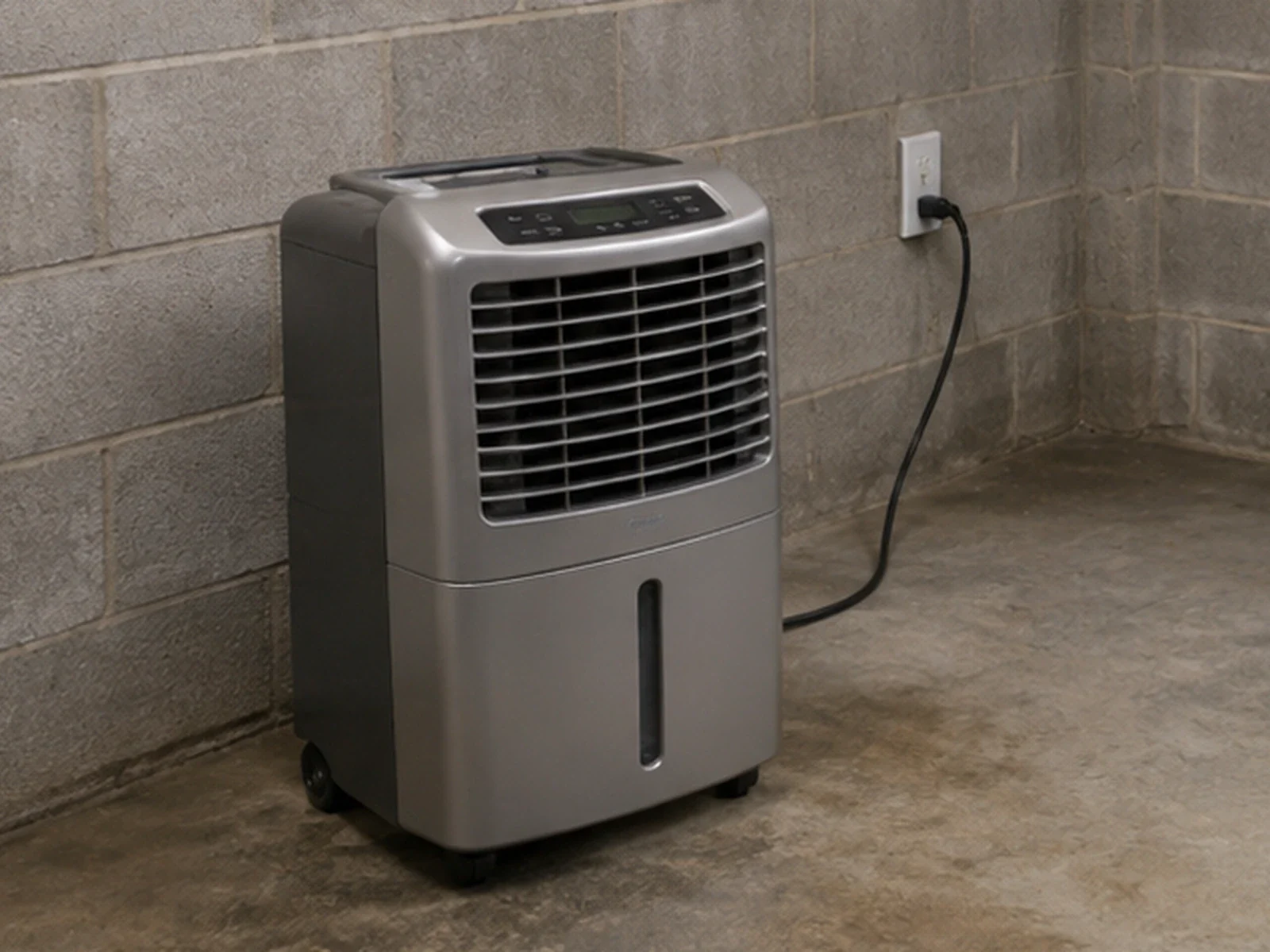
Most basements need a dehumidifier sized to the square footage and how damp the space is. Bob Vila’s sizing rule is about 10 pints of capacity for 500 square feet, plus 4 pints for each additional 500 square feet. That makes a 1,000-square-foot basement about 14 pints under the rule, before you adjust for dampness.
Real conditions need more. One retailer guide advises a larger unit for basements with visible seepage or a flooding history, and says the right size runs one to two cycles a day at your target humidity, while a unit that runs constantly is undersized. Ratings also changed: the U.S. Department of Energy changed its test conditions, so newer pint ratings are lower and more realistic than older labels. Compare units by the current rating.
- Set the humidistat to 45% to 50% in summer and lower in winter if surfaces sweat
- Drain it with a hose or pump so it does not stop when the bucket fills
- Keep it away from walls and stored items so air moves around it
- Clean the filter and coils on the schedule in the manual
Angi lists $500 to $1,200 per dehumidifier in Columbus. A unit does not fix a leak, though. If water keeps entering, the dehumidifier runs day and night just to keep up.
What else lowers basement humidity?
Reduce the moisture that gets in before you remove it. The cheapest steps handle air and water sources first, and the University of Georgia Extension lists the basics: repair leaks, run exhaust fans, clean gutters, and keep water draining away from the house.
- Wrap cold-water pipes with foam insulation so they stop sweating
- Seal gaps where pipes and wires pass through walls and floors
- Vent the dryer to the outdoors and run bath and kitchen exhaust fans
- Clean gutters and extend downspouts so water does not collect near the wall
- Avoid drying laundry in the basement, and keep stored items off the floor
- Use a vapor barrier or sealer where moisture passes through walls
Angi lists vapor barriers at $950 to $2,100 and waterproofing paint at $1 to $8 per square foot in Columbus. Treat a surface coating as a small part of the fix, because it does not stop water pushing through the wall.
When is high humidity a waterproofing problem?
If humidity stays above 60% with a dehumidifier running, look for a water source. A properly sized unit should reach target within a day or two. A unit that runs constantly and cannot hold the number is a sign that liquid water or vapor is coming through the walls or floor.
- Water stains, efflorescence, or damp patches at the base of the walls
- Humidity that jumps after storms
- A floor that feels damp or shows wet spots
- A sump pit that fills often or smells musty
- A musty odor that returns after cleaning
Columbus gives these problems a lot to work with. The city averages about 39.31 inches of rain a year, and August 2026 delivered 9.94 inches against a normal 3.74. After that kind of month, a basement can stay damp for weeks. The EPA says that if wet materials are dried within 24 to 48 hours, mold usually will not grow, so speed matters after any wet event.
When the cause is water pressure, the right fix is drainage or sealing, not a bigger dehumidifier. Our pages on interior drainage, sump pump installation, and basement wall sealing explain those repairs, and a written quote should name the source of the moisture before it names a product. If the number will not come down, ask our Columbus basement waterproofing team to find where the moisture is coming from.
Humidity targets: EPA, North Carolina Department of Health, and University of Georgia Extension. Columbus climate: NOAA data as summarized for Columbus, and Weatherspark. Prices: Angi, Columbus.
Share this article :