Why homeowners choose us
Fast Response
Quick scheduling and rapid help when water is actively entering.
Transparent Pricing
A clear quote after inspection and before any work starts.
Fully Insured
The contractors we work with carry insurance, explained before any work begins.
Local Expertise
Experienced waterproofing crews who know Central Ohio homes.
Our process
- 1
Trace Water
We find where water enters and how it moves along the footing.
- 2
Cut Channel
A drain channel is opened along the inside of the footing.
- 3
Set Drain
Drain pipe and stone send seepage to the sump pit.
- 4
Restore Floor
The floor is patched and a walkthrough covers upkeep.
What does interior drainage installation involve in a Columbus basement?
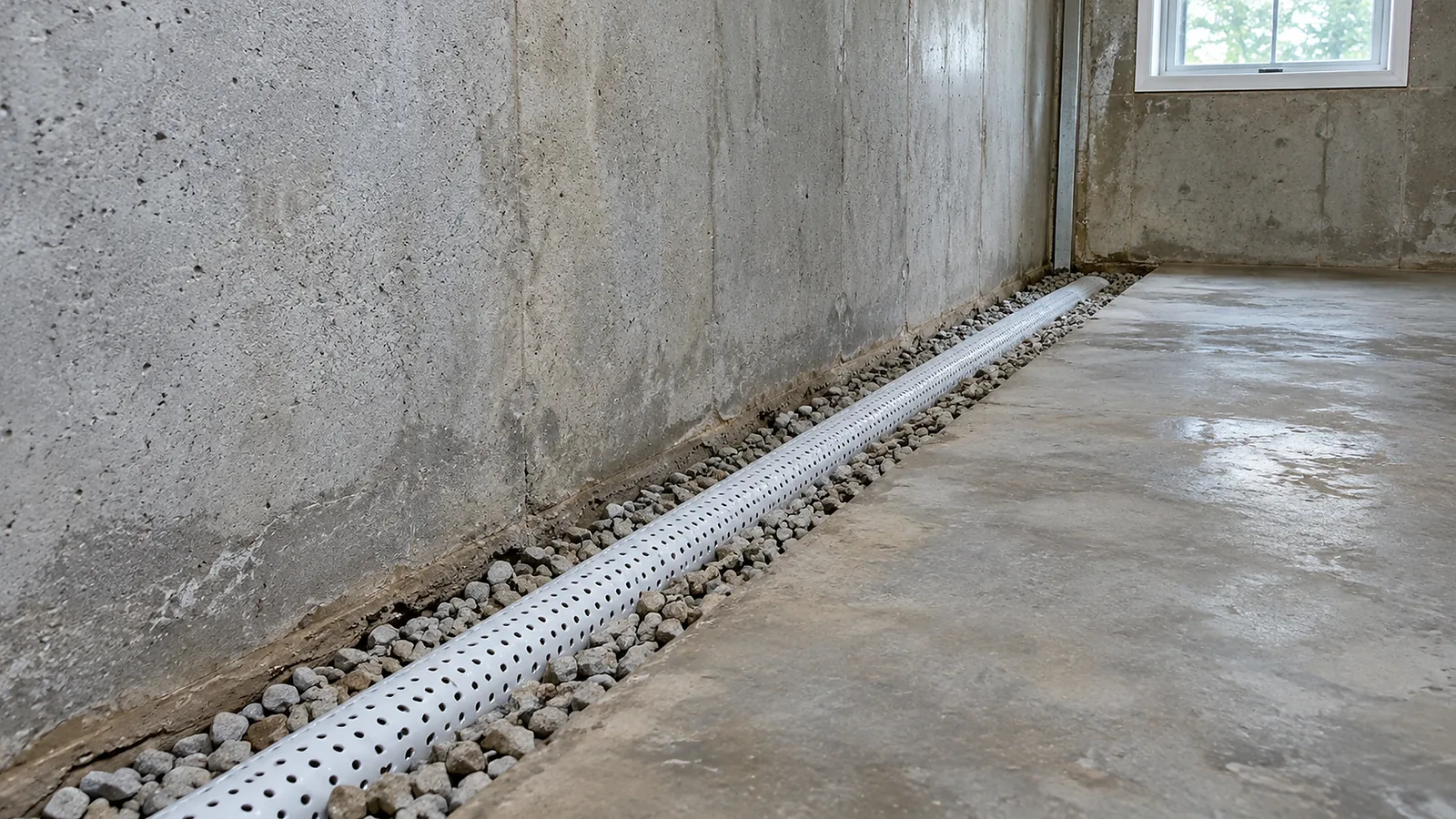
Interior drainage installation means cutting a trench along the inside of the basement walls, laying perforated pipe at the footing, and routing the water it collects to a sump pit where a pump sends it outside. In a Columbus basement the finished system sits under a narrow strip of new concrete, so the floor looks the same as before the work.
A perimeter job on an unfinished basement usually runs in this order:
- Mark the drain path and move anything stored along the walls
- Cut and remove a narrow strip of slab along the wall
- Dig the trench to the footing, then set gravel and the perforated pipe
- Connect the pipe to a sump pit, cutting a new pit if the basement has none
- Cover the pipe with gravel and pour new concrete over the trench
- Run water through the system to confirm it flows to the pit and out
The slab work is loud and dusty while it lasts, so a good crew closes off doorways and runs vacuums on the saws. The system should be tested with water before the crew leaves, because a drain that has never carried water has only been assumed to work.
Why do Columbus basements need an interior drain?
Columbus basements need interior drains because groundwater builds pressure under the slab and against the walls, and it escapes at the joint where the floor meets the wall. Engineers call that force hydrostatic pressure. A drain relieves it by giving the water a path to the sump instead of letting it push through the concrete. Basement Systems notes that coatings and membranes let that pressure build, while a drainage system reduces it.
Columbus gives the pressure plenty to work with. The city averages about 39.3 inches of precipitation a year, and the National Weather Service recorded 55.18 inches in 2018. Ohio State research found that Columbus days with more than 1.25 inches of precipitation rose 78% between 1951 to 1980 and 1981 to 2010, and on August 20, 2026, a single day brought 2.87 inches, a record for that date. Franklin County soils formed on glacial till with a lot of silt and clay, and clay drains slowly, so water lingers around a foundation long after the rain stops.
The signs that water is coming from below are easy to spot. Look for a damp or darker strip along the base of the wall after rain, white mineral powder on the concrete, a musty smell that gets worse in wet weeks, and rust on the feet of the furnace or water heater. If those show up at the wall and floor joint rather than in the middle of the wall, an interior drain is aimed at exactly the right spot.
How much does interior drainage installation cost in Columbus?
Interior drainage installation is priced by the linear foot, and national cost guides put it between about $40 and $120 per foot. HomeAdvisor lists weeping tile systems at $60 to $120 per linear foot. HomeGuide puts interior French drains at $40 to $85 per foot, or $4,000 to $17,000 for the whole job. No Columbus-specific average has been published, so treat these as benchmarks. For a wider look at what Columbus homeowners pay, see our guide to how much basement waterproofing costs in Columbus.
The first step is measuring your walls. A 25 by 40 foot basement has about 130 feet of wall, so a full perimeter at HomeAdvisor’s rate runs roughly $7,800 to $15,600 before the sump pump. A drain along one problem wall costs far less. A contractor guide puts a 100-foot interior job at $4,000 to $10,000. Exterior excavation, by comparison, was priced at $120 to $220 per linear foot in Angi’s earlier cost guide, which is why the interior route is usually the cheaper one. Ask for the quote in feet and dollars per foot, so you can compare bids. A lower total that covers 60 feet when your basement needs 130 is not a lower price.
Several things move the per-foot rate. HomeAdvisor ties it to the depth of the trench and how easy the walls are to reach. A finished basement costs more because the flooring and wall finish have to come out. A basement without a pit adds the cost of the pit and pump, which Angi lists at $800 to $3,000 for a professional sump installation. The slab work and the drainage pipe are specialist jobs, so interior drains are not a realistic do-it-yourself project.
Which kind of interior drain fits a Columbus basement?
A perimeter drain at the footing fits most Columbus basements where water shows up at the wall and floor joint after rain. It is the heaviest-duty option, and it handles the water that builds under the slab. A baseboard channel sits on top of the floor at the wall and collects water running down the wall face. Angi lists baseboard channels at about $30 per linear foot, and HomeGuide gives $30 to $150, so they cost less but suit lighter seepage. A sub-slab drain runs under the middle of the floor and is used when water rises through the slab instead of the walls.
Where the water appears decides the choice. A damp strip along one wall points to a partial perimeter drain or a channel. Wet patches in the middle of the floor point to a sub-slab line. Water at every wall points to a full perimeter system. An inspector should point to your stains and explain why one type suits the pattern, rather than sell the biggest system by default.
How long does interior drainage installation take in Columbus?
Most interior drainage systems are installed in one to three days. Basement Systems says most of its installations take two days or less, and other contractor guides give one to three days for a typical basement. Finished basements take longer, up to about a week, because flooring and wall finishes along the drain path have to come out and go back in, and the new concrete needs time to cure.
Interior work does not depend on the weather, which matters in Columbus. Franklin County uses a 32-inch frost depth for construction, and winter ground can delay exterior digging for weeks. A crew can open the slab in January as easily as in June. While the trench is open, the edge of the room is off limits, but the rest of the house is largely unaffected. If water has already reached the floor, dry wet materials within 24 to 48 hours, as the EPA advises, and run a dehumidifier until the drain is in. Porous materials that stay wet for more than 48 hours are likely to grow mold, according to Harvard’s environmental health office.
Does an interior drain need a sump pump and a permit in Columbus?
An interior drain needs a sump pump in nearly every Columbus basement, because the pipe collects water and the pump moves it out. If a working pump already sits in the basement, the contractor can often tie the drain into the existing pit, provided the pit is large enough for the extra flow. The discharge line should empty outdoors, well away from the foundation. Bexley and Grandview Heights both prohibit connecting storm or ground water to the sanitary sewer, and Columbus City Code 1145.86 limits what can go into its storm sewer, so ask your city which outlet applies.
The pump connection is plumbing work. PermitFlow’s Columbus guide says the city requires plumbing permits for new installations, and Franklin County requires a valid license for plumbing work. In many Franklin County suburbs, plumbing permits go through Franklin County Public Health, and New Albany’s application lists sump pumps among its fee items. Ask the contractor which office covers your address and who pulls the permit.
When does a Columbus basement need more than an interior drain?
A Columbus basement needs more than an interior drain when the problem is not water at the floor. A drain does not fix a wall that is bowing inward, a crack that is widening, or a yard that slopes toward the house. Angi says cracks wider than 1/8 inch, or raised on one side, could indicate structural damage, and a horizontal crack should be looked at by a structural engineer before any waterproofing is chosen.
Gutters matter too. A downspout that empties beside the foundation can overwhelm any drain, and moving it costs a small fraction of the drain itself. If the inspection finds one of these causes, the better plan combines the drain with crack repair, regrading, or downspout extensions. A good contractor will say so up front, even though it makes the quote more complicated. Exterior waterproofing becomes worth considering when water is coming through the wall itself instead of at the floor joint, or when the foundation wall is failing and needs to be reached from outside.
How do you hire an interior drainage contractor in Columbus?
Hire a Columbus interior drainage contractor who will put the drain length, the discharge route, and the warranty in writing before the slab is opened. Ask for these items on the quote:
- The drain path on a sketch or photo, with the total linear feet and the price per foot
- How the sump pit and pump are handled, and whether the permit is included
- Proof of liability insurance; the contractors we work with carry insurance coverage, and you should still ask to see it
- A written warranty that says what is covered and for how long, including the pump and the concrete patch
Also ask what flooring or wall repair is included if the basement is finished, and what happens if water still shows up after the first heavy rain. Compare bids line by line, and be cautious of any quote that is far below the others without a clear reason. Expect a clear answer on cleanup too: who hauls away the concrete and dust, how the patch is finished, and whether you will be able to use the basement while the concrete cures.
When to call a professional. Call if water appears along the wall-floor joint after rain, if a damp patch keeps returning, or if the basement smells musty. The sooner the entry point is found, the simpler the repair usually is.