Why homeowners choose us
Fast Response
Quick scheduling and rapid help when water is actively entering.
Transparent Pricing
A clear quote after inspection and before any work starts.
Fully Insured
The contractors we work with carry insurance, explained before any work begins.
Local Expertise
Experienced waterproofing crews who know Central Ohio homes.
Our process
- 1
Plan Route
We map low spots, slope, and the outlet.
- 2
Dig Trench
A sloped trench is cut along the route.
- 3
Lay Pipe
Perforated pipe, fabric, and gravel go in.
- 4
Finish Surface
Soil and sod or stone are restored.
What does French drain installation involve in a Columbus yard or basement?
A French drain is a sloped, gravel-filled trench with a perforated pipe that collects water in the soil and carries it to a safe outlet. It works in two places: outside, where it relieves a soggy yard or a wet foundation wall, and inside, where it runs along the basement floor edge and leads to a sump. In Columbus the job usually starts with finding out where the water comes from and where it can legally go.
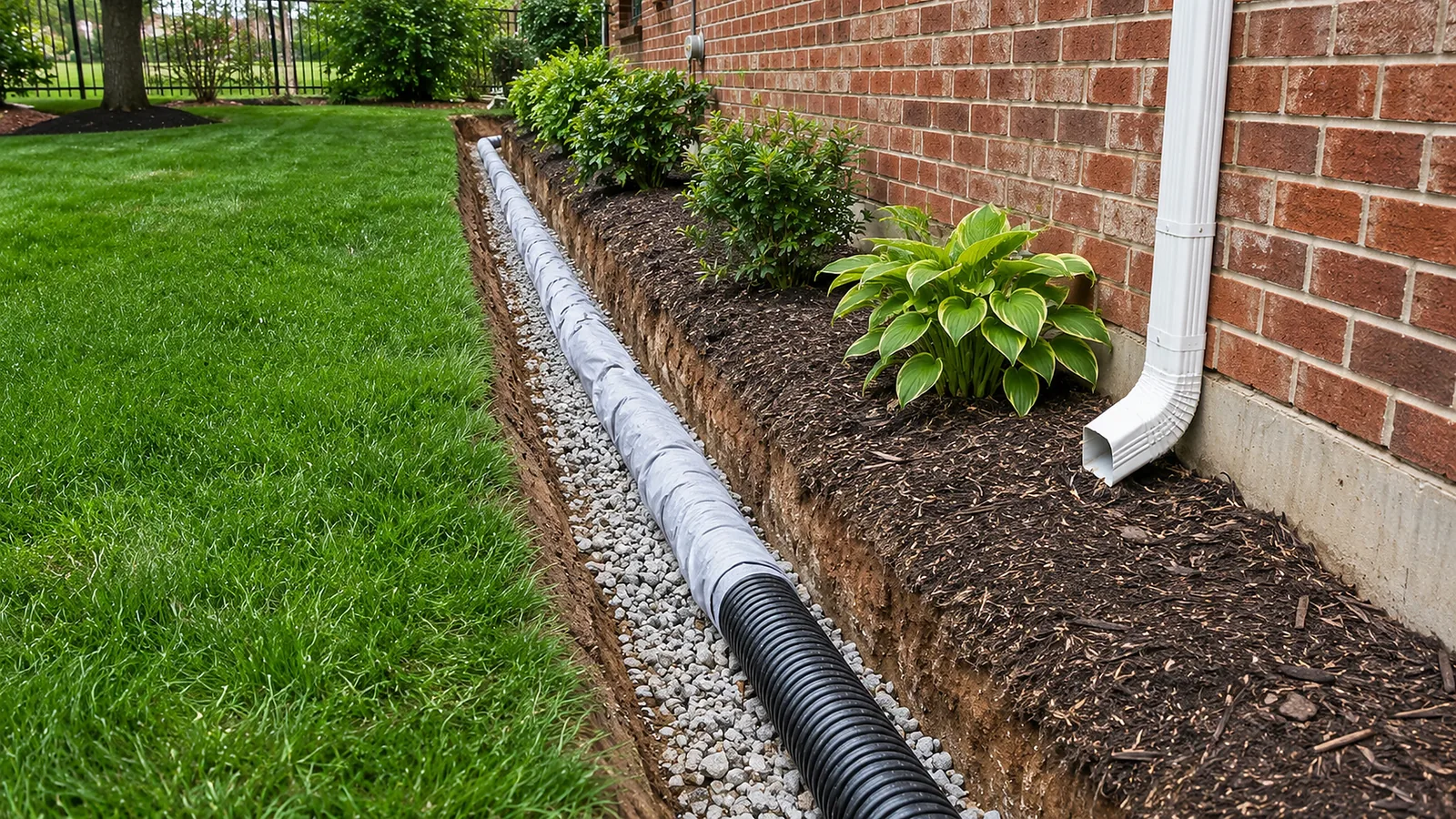
An exterior drain follows this order:
- Mark the underground utilities and lay out the route from the wet area to the outlet
- Dig a trench with a steady downhill fall toward the outlet
- Line the trench with non-woven filter fabric and add a base layer of washed stone
- Lay the perforated pipe with the holes facing down
- Cover the pipe with more stone, fold the fabric over the top, and restore the surface
An interior drain follows a different route. The crew cuts a channel in the basement slab along the wall, lays the pipe in stone, and patches the concrete. The pipe leads to a sump pit, since gravity alone rarely carries the water out of a basement. Both versions share one rule: the drain only works if the water has somewhere to go.
Why do Columbus properties need a French drain?
Columbus properties need a French drain when water collects faster than the soil can absorb it. The city averages about 39.31 inches of rain a year, and 2018 set a record at 55.18 inches. Ohio State researchers found that days with more than 1.25 inches of precipitation rose 78% between 1951 to 1980 and 1981 to 2010.
The ground makes it harder. The New Albany city site notes that some areas in Franklin County have clay-heavy, poorly draining soils, and that about 85% of the land in Ohio is affected by a seasonally high water table. Additions, mature shrubs, and soil movement also change drainage patterns, often sending water toward foundation walls. When the backfill around a basement drains differently from the soil around it, water can collect against the wall like water in a bowl.
The usual signs are water pooling along the foundation after rain, a low spot in the yard that stays soggy for days, damp basement corners, and soil washing away beside the house. Check the simple causes first. New Albany’s guidance for Franklin County homeowners says downspouts and any sump discharge should end at least 3 to 4 feet from the foundation. If extending them solves the pooling, a drain may not be needed. Our guide on why a Columbus basement leaks after heavy rain walks through how to trace each entry point.
Which French drain fits: exterior, interior, or curtain?
An exterior drain fits a wet yard or a leaking foundation wall, an interior drain fits a basement that takes in water through the floor and wall joint, and a curtain drain fits a sloped lot where water runs toward the house from above. The right one depends on where the water enters, not on which is cheapest.
- Exterior or yard drain: collects water in the soil and from the surface and carries it away from the house
- Footing drain: sits at the base of the foundation, below the slab level, and is often part of an exterior waterproofing job
- Interior drain: runs inside the basement along the wall and leads to a sump pit
- Curtain drain: a shallower trench uphill of the house that intercepts water before it arrives
Angi describes curtain drains as easier to install because they sit nearer the surface, while interior systems are built into basements around the foundation. A yard drain cannot fix a leak that comes from a failed wall coating. If water is coming through the wall itself, the answer may be exterior waterproofing instead, which is covered on our exterior waterproofing page.
How much does French drain installation cost in Columbus?
French drain installation in Columbus most likely costs between $10 and $100 per linear foot, with yard drains at the low end and basement drains at the high end. These are national figures, and the closest local number is broader: HomeAdvisor lists a Columbus average of $6,997 for drain services, with a typical range of $2,602 to $11,966. That figure covers all kinds of drain work, so treat it as a ceiling check, not a quote.
The type of drain moves the price. HomeAdvisor says exterior French drains run around $10 to $50 per linear foot, up to $100 for complex installs. Interior basement drains average $40 to $100 per linear foot, or $5,000 to $18,000 in total, and most basements need between 100 and 150 linear feet. Bob Vila’s guide reports a national average near $5,000, from $500 for minimal work up to $18,000 for an extensive system. HomeGuide puts an exterior footing drain at $1,500 to $4,000 per side of the house and an underground downspout line at $150 to $350 per downspout.
Trench depth, access, and soil are the big price levers. A shallow drain across an open lawn is cheap, and a deep trench beside a foundation, through clay, with a patio to remove costs far more. Interior work adds concrete cutting and patching, and a sump pump costs extra. Get itemized bids so you can see pipe, stone, fabric, labor, and restoration as separate lines.
How deep, how steep, and what goes in the trench?
A residential yard French drain is typically 18 to 24 inches deep and 9 to 12 inches wide, with the pipe falling at least 1% toward the outlet. That fall works out to 1 inch of drop for every 8 feet of pipe. Without it, the pipe becomes a gravel-filled ditch that holds water instead of moving it.
The materials matter as much as the dimensions:
- Pipe: 4-inch perforated pipe, laid with the holes facing down
- Stone: washed gravel, 3/4 to 1.5 inches, not rounded pea gravel, which compacts
- Fabric: non-woven geotextile that wraps the stone, so soil cannot wash into it
- Outlet: a daylight discharge, a dry well, or a storm connection that is allowed at your address
Skipping the fabric is the most common shortcut. One inspector’s guide calls it the number one reason French drains fail within 5 to 10 years. Depth also interacts with Franklin County’s 32-inch frost depth. A yard drain at 18 to 24 inches sits inside the frost zone, so the soil around it freezes and thaws every winter, and good backfill and compaction help the trench resist settling. Footing drains sit below frost depth because they sit at the footing.
Do French drains work in Columbus clay, and how long do they last?
French drains can work in Columbus clay, but clay makes the design more demanding and the drain more likely to clog. Water moves slowly through clay, so drains may need to be placed closer together, set deeper, or paired with surface inlets, according to a drainage contractor’s guide. NDS notes that heavy clay can keep water from reaching the pipe efficiently. A drain that is fabric-wrapped and surrounded by washed stone gives water a fast path that the clay does not.
Angi lists French drain lifespans from 10 to 40 years, and also says 30 to 40 years with regular maintenance. A contractor guide cuts that to 5 to 10 years when corners are cut on fabric, stone, or slope. Angi warns that clay and debris can build up in the pipe and call for a plumber, and one installer notes that clay-heavy ground makes pipes clog faster.
Maintenance is mostly watching. Clear leaves from grates and catch basins each fall, and check the outlet after heavy storms to confirm water is flowing. If the trench was built with a cleanout, flush it every few years. Water that stops running from the outlet after a storm is the sign that the pipe is blocked.
Where should the water go, and what do the rules say?
The water should end up in a place that does not hurt your house or your neighbor’s: a storm system you are allowed to use, a daylight outlet on your own lot, or a sump. The City of Columbus says property owners are generally responsible for grading that moves stormwater away from the house and toward the nearest storm sewer or drainage system. Columbus City Code 1145.86 also limits what can enter the storm sewer to stormwater.
Neighbors matter. New Albany’s guidance warns that changing the flow of water in a way that damages an upstream or downstream neighbor can create legal liability. Aiming a drain at a property line is a common way to start a dispute. The Franklin Soil and Water Conservation District offers drainage help to homeowners, and a contractor should be willing to explain where your outlet will empty.
Ohio law requires the person digging to call OHIO811 at least 2 working days before starting, and no more than 16 calendar days ahead. Ask who is placing that call. Permit rules vary by address, and tying a drain into a sump or storm line can need a plumbing permit. Ask the contractor which Columbus or Franklin County office covers your home. The discharge point is the part most likely to run into rules, so settle it before the trench is dug.
How do you hire a French drain contractor in Columbus?
Hire a Columbus French drain contractor who finds the source of the water first and names the outlet in writing before any digging starts. A bid that gives a price per foot without a site visit leaves out the two things that drive cost: depth and discharge. Ask for these on the quote:
- Where the water enters, and why a drain is the right fix rather than gutters or grading
- Pipe size, stone type, filter fabric, and trench depth and slope
- The outlet location, and whether a sump pump, permit, or neighbor notice applies
- A license or registration where your city requires one, and proof of liability insurance; the contractors we work with carry insurance coverage, and you should still ask to see it
- What gets restored, such as lawn, edging, or concrete, and the warranty terms
Compare at least three itemized bids. A contractor who recommends downspout extensions or regrading before a drain is thinking about your water, not just your invoice. After the work, watch the outlet during the next hard rain and keep the OHIO811 ticket number with the paperwork.
When to call a professional. Call if water pools along the foundation after rain, a low spot stays soggy for days, or downspout extensions do not move enough water.