Why homeowners choose us
Fast Response
Quick scheduling and rapid help when water is actively entering.
Transparent Pricing
A clear quote after inspection and before any work starts.
Fully Insured
The contractors we work with carry insurance, explained before any work begins.
Local Expertise
Experienced waterproofing crews who know Central Ohio homes.
Our process
- 1
Map Cracks
We mark and measure every crack and note where water appears.
- 2
Prep Wall
The crack is cleaned and opened for a good bond.
- 3
Seal Crack
Epoxy or polyurethane is injected to fill the crack.
- 4
Monitor Wall
We note cracks to watch and check drainage outside.
What does foundation crack repair involve in a Columbus basement?
Foundation crack repair means sealing a crack in a poured concrete basement wall by injecting resin into it, usually from the inside of the basement and without any digging. In a Columbus basement the work targets a specific crack, not the whole wall, and it can be done in any season because it does not depend on the weather outside.
A typical injection visit follows this order:
- Clean the crack and the wall around it so the resin can bond
- Mount small plastic ports along the crack at set intervals
- Seal the surface of the crack with a paste so the resin has nowhere to escape
- Inject the resin from the lowest port up, until it shows at the next port
- Return to each port to top it off, then remove the ports and grind the surface smooth
Done correctly, the resin fills the full depth of the wall, not just the face. That depth is the difference between a repair that holds and a surface patch that peels. Caulk and hydraulic cement are not substitutes, because both tend to fail when the wall moves or stays wet. Working from the inside also avoids the exterior dig, which helps where a deck, patio, or fence sits against the wall, and it means the yard and landscaping stay untouched.
Why do Columbus basement walls crack?
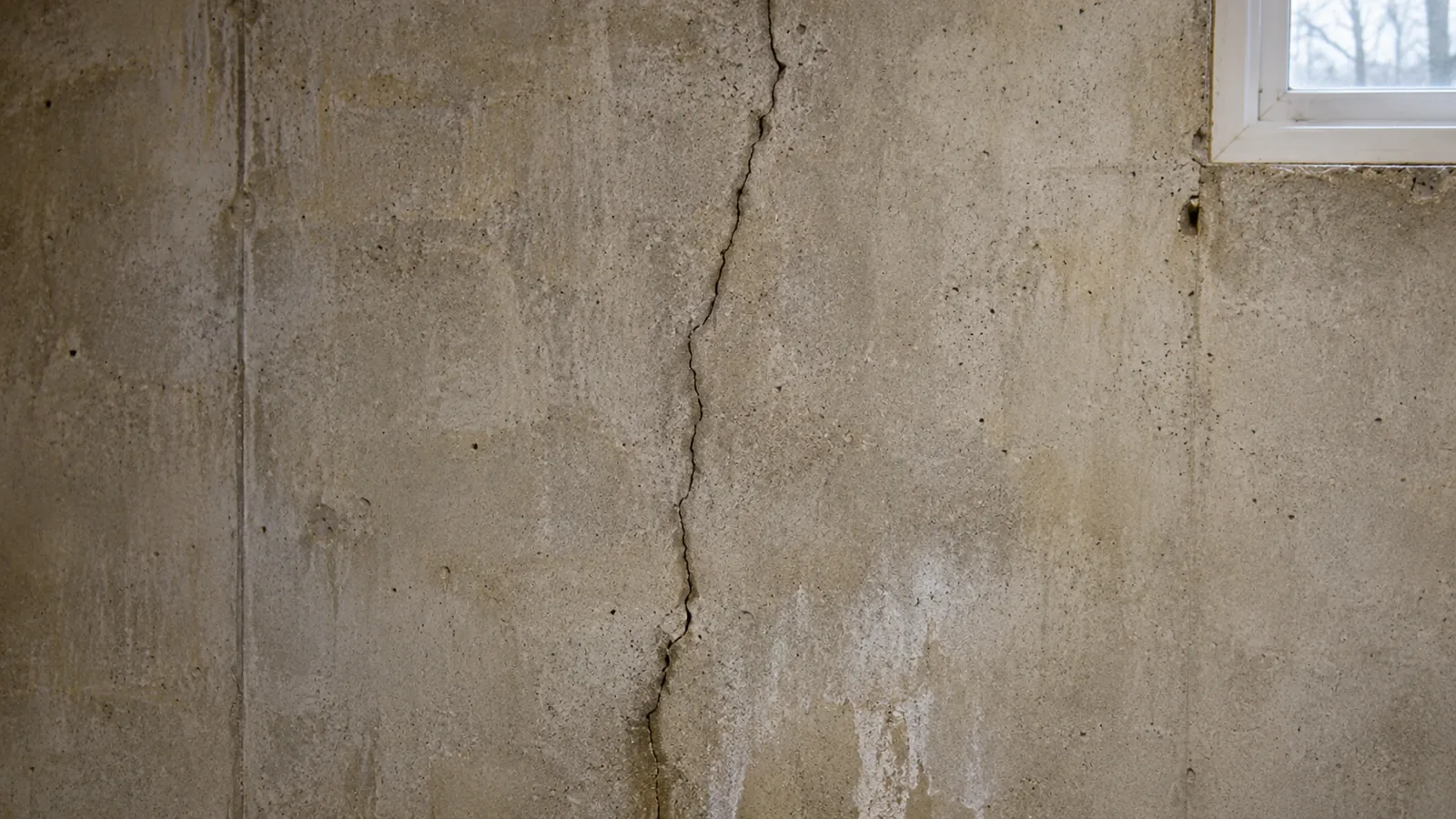
Columbus basement walls crack mostly because poured concrete shrinks as it cures, and the soil and weather around the wall keep working on it afterward. Most cracks in a poured wall are shrinkage cracks, usually straight up and down, and they appear in nearly every poured foundation. They are an entry path for water, though. Once a crack has leaked, it will leak again with every good rain.
Local conditions widen them. Columbus averages about 39.3 inches of precipitation a year, and the National Weather Service recorded 55.18 inches in 2018. Ohio State research found that Columbus days with more than 1.25 inches of precipitation rose 78% between 1951 to 1980 and 1981 to 2010. Franklin County uses a 32-inch frost depth for construction, so the soil beside a basement wall freezes and thaws every winter, and clay-heavy soil holds water against the wall between storms. Several seasons of that cycle can turn a hairline crack into a wider one. Our article on whether Columbus winters cause foundation cracks explains the frost-depth and freeze-thaw side of this.
Water pressure plays a part as well. When groundwater saturates the soil around the foundation, the pressure against the wall rises, and a crack becomes the easiest path for that water to reach the basement. That is why a crack that stayed dry through a normal year can start to seep after a wet spring, and why fixing gutters and grading belongs in the same conversation as the repair.
How do you tell which Columbus foundation cracks are serious?
Three things decide how serious a crack is: its direction, its width, and whether the two sides still line up. A thin vertical crack with both sides flush is almost always shrinkage. Angi says cracks wider than 1/8 inch, or raised on one side, could indicate structural damage, and several other guides place their line at 1/4 inch. A crack that is wider at the top than at the bottom suggests the wall is moving, and stair-step cracks in block walls follow the mortar joints and usually mean settlement.
Horizontal cracks deserve the most caution. They usually mean soil pressure is pushing the wall inward, and injecting resin into one does not stop the wall from moving. To watch a crack, mark both ends with a pencil and write the date beside each mark. If the crack grows past a mark within a few months, it is active. Check again after a wet spring and after the first hard freeze. A crack that has not moved in a year and is not leaking can often be sealed once and left alone.
Epoxy or polyurethane: which seals a Columbus basement crack?
Polyurethane is usually the better seal for a basement crack that leaks, and epoxy is usually the better choice for a dry, stable crack. Epoxy is rigid and bonds the two faces of the concrete back together, but U.S. Waterproofing notes it will not stick to wet concrete. Polyurethane is a flexible foam that expands when it meets water and fills the crack from the inside out. It stops water but does not restore strength, and it can handle a little seasonal movement.
For ordinary shrinkage cracks in a residential wall, either one usually works. Waterproofing Magazine puts it plainly: in most cases the best material is the one the contractor is most comfortable using. What matters in a Columbus basement is the crack’s condition on the day of the repair. A wall that is streaming water in April needs polyurethane. A dry crack in a stable wall in August is a good candidate for epoxy. Ask the contractor why the chosen material suits your crack. Epoxy has one advantage in a dry wall: it stays liquid during injection, which gives it extra time to work into tight hairline cracks, while polyurethane reacts and expands as soon as it touches moisture.
How much does foundation crack repair cost in Columbus?
Foundation crack repair in Columbus most likely costs about $250 to $900 per crack for professional injection, based on national cost guides. Several guides put epoxy at $250 to $800 per crack and polyurethane at $300 to $900, and Angi lists a do-it-yourself injection kit at $100 to $400. No Columbus-specific average has been published, so these are national benchmarks, not local bids.
A short crack in an easy-to-reach spot costs less, and a long crack in a tight corner or behind finished walls costs more. A basement with five or six cracks is sometimes quoted as one flat-rate job. If the crack is part of a bigger problem, the numbers climb: HomeAdvisor’s survey of 4,040 members found typical foundation repairs between $2,178 and $7,840, and Angi’s figure sits between $2,218 and $8,111. A DIY kit looks cheap, but it skips the diagnosis, which is where most of a professional’s value lies. Ask for a quote that lists each crack, its length, the material, and the price.
How long does crack repair take, and will it last?
A single crack injection usually takes a few hours, and a basement with several cracks can be finished in one day. One homeowner account describes the job as a single afternoon. The resin needs time to cure before the wall is fully sealed, and the crew should tell you how long to wait before testing it or finishing the wall.
A correct injection should hold for years, because the resin fills the full depth of the crack. A repair can fail if the wall is still moving, if the material was wrong for the conditions, or if the resin did not fill the whole depth. Wet weather can delay the work, since a wall streaming water has to be handled differently than a dry one. Ask what the warranty covers if the crack reopens, and whether the contractor will return to look at it. After the repair, watch the wall during the next heavy Columbus rain and mark the spot with a pencil. A dry crack after the first real storm is the best early sign the repair worked.
When does a Columbus crack need an engineer instead of an injection?
A Columbus crack needs a structural engineer when it is horizontal, when the wall bows inward, when one side sits higher than the other, or when doors and windows upstairs start to stick. Injection treats a crack. It does not treat the reason the wall cracked, and picking a repair before knowing the cause is how the same crack ends up being paid for twice.
Repairs for walls under real pressure cost far more. Carbon fiber straps for a bowing wall run roughly $600 to $1,500 per strap depending on the source, and guides put horizontal-crack repairs anywhere from $4,000 to $15,000 or more, because they can involve carbon fiber, steel beams, or wall anchors. Paying for an engineer’s assessment first costs far less than injecting the wrong crack. Fixing drainage helps too: gutters that dump at the foundation and soil that slopes toward the house add the pressure that pushes walls inward.
How do you hire a foundation crack repair contractor in Columbus?
Hire a Columbus crack repair contractor who will name the crack, the material, and the reason in writing before any resin goes in. Ask for these items on the quote:
- Which crack is being repaired, how long it is, and which material will be used
- Why that material suits the crack: wet or dry, moving or stable
- A license or registration where your city requires one, and proof of liability insurance; the contractors we work with carry insurance coverage, and you should still ask to see it
- Warranty terms, including whether a crack that reopens is covered
If the repair involves structural work such as straps, anchors, or a wall rebuild, ask which permit applies. Columbus and Franklin County handle building permits differently depending on the address, and the contractor should tell you which office covers your home. If someone quotes the same price for every crack without looking at them, keep looking. A contractor who measures each crack, asks whether it leaks, and explains the choice between epoxy and polyurethane is doing the diagnosis the price should include.
When to call a professional. Call if a crack is leaking, growing, or if a wall bows inward or shifts. Horizontal cracks and bowing walls need prompt attention.