Why homeowners choose us
Fast Response
Quick scheduling and rapid help when water is actively entering.
Transparent Pricing
A clear quote after inspection and before any work starts.
Fully Insured
The contractors we work with carry insurance, explained before any work begins.
Local Expertise
Experienced waterproofing crews who know Central Ohio homes.
Our process
- 1
Clear Space
We clear debris and check for damage.
- 2
Fix Drainage
Any source of standing water is corrected.
- 3
Seal Floor
A vapor barrier covers floor and walls.
- 4
Seal Vents
Vents and seams are sealed and checked.
What does crawl space encapsulation involve in a Columbus home?
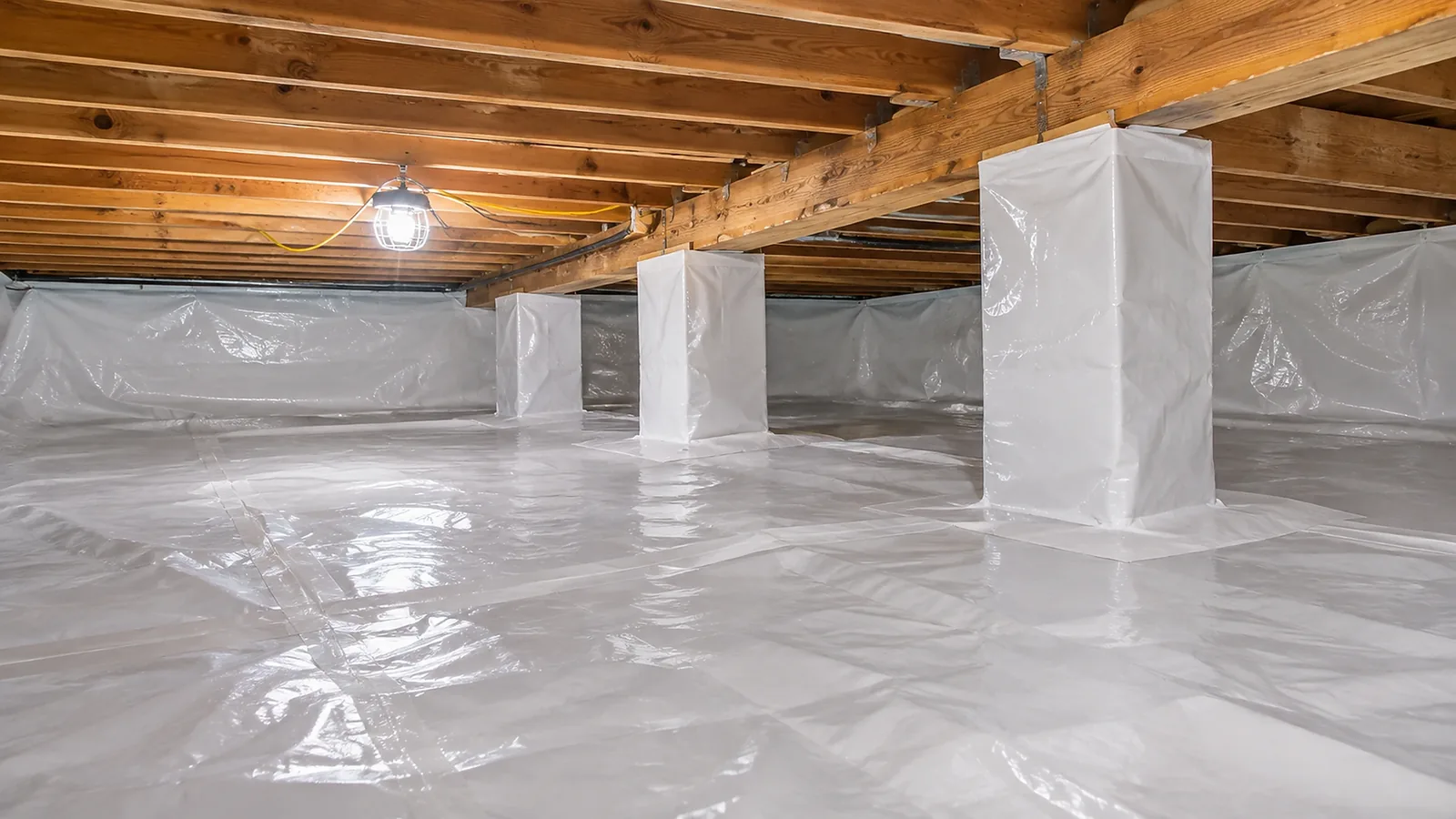
Crawl space encapsulation means sealing the crawl space from the soil and the outdoors with a heavy plastic liner, sealed vents, and usually a dehumidifier, so the air under the house stays dry. In a Columbus home it applies to the crawl spaces under ranches, additions, and older houses, not to full basements. The goal is a space that behaves like a small, dry basement instead of a vented pit that breathes in outdoor air.
A complete job follows this order:
- Clear debris, old insulation, and standing water, and fix any water source first
- Cover the dirt floor in one continuous vapor barrier
- Run the liner up the foundation walls and fasten it, then tape every seam
- Seal the foundation vents and the access door
- Install a dehumidifier, or condition the space with supply air, and set it to hold the target humidity
- Add wall insulation if the plan calls for it
Energy Vanguard lists the basic features as full ground coverage, sealed seams and junctions, sealed vents, and usually insulated foundation walls. Sealing and encapsulating are not the same thing. Groundworks says sealing usually means closing vents and repairing leaks, while encapsulation includes the barrier, insulation, dehumidifier, and other moisture management.
Why do Columbus crawl spaces get damp?
Columbus crawl spaces get damp from three sources: groundwater and rain, moisture rising out of the soil, and warm summer air that condenses on cool surfaces. The city averages about 39.31 inches of rain a year, and July is the wettest month at roughly 4.7 inches. Ohio State researchers found that days with more than 1.25 inches of precipitation rose 78% between 1951 to 1980 and 1981 to 2010.
A vented crawl space makes the problem worse in summer. Humid outdoor air enters through the vents, meets the cooler soil and ductwork, and leaves moisture behind. Fine Homebuilding calls a vented crawlspace a recipe for mold and moisture, and the Energy Vanguard series says vented crawl spaces have a number of problems that seriously degrade a home’s performance. A pest-control firm’s guide puts the line at 60% relative humidity, above which the space attracts pests, mold, and mildew.
Bulk water is a separate matter. A liner stops moisture rising from the soil, but it is not a cure for leaks. Ohio Basement Authority itself says a vapor barrier is not entirely effective against water seepage from leaks. If water enters from the wall or collects after storms, the fix may be a drain, a sump, or exterior drainage first. Franklin County has clay-heavy, poorly draining soils in places, and clay holds water against a foundation long after the rain stops.
How do you know a Columbus crawl space needs encapsulation?
A Columbus crawl space needs encapsulation when you find a musty smell, damp or sagging insulation, mold on wood, or floors above that feel cold and soft. Any one of those means moisture has been in the space long enough to leave a mark. If you can smell it upstairs, the air is already moving up from below.
Check these before you call anyone:
- Relative humidity: a basic hygrometer left in the space for a week shows whether it stays above 60%
- Wood: probe joists and the sill plate with a screwdriver; soft wood means rot has started
- Insulation: look for fiberglass batts that sag, stain, or sit on the ground
- Pests and droppings, which follow moisture
- Soil: bare dirt that is wet, or a liner that is torn or missing
Homes with a dirt floor are the usual candidates. Building code already expects a closed crawl space to have its exposed earth covered with a continuous vapor retarder, with seams taped and the edges running at least 6 inches up the stem wall. A crawl space that has none of that is a good place to start the conversation.
How much does crawl space encapsulation cost in Columbus?
Crawl space encapsulation in Columbus most likely costs about $3 to $7 per square foot, putting many full projects between $5,000 and $15,000. These are national industry estimates, because no Columbus average has been published. Per-foot ranges vary a great deal: Angi gives $2 to $4 per square foot for basic work and $3 to $10 for extensive jobs, according to a cost compilation. For size-by-size figures and add-on costs, see how much crawl space encapsulation costs in Columbus.
What the quote includes explains most of the gap. A liner alone is the cheapest option. Adding sealed vents, taped seams, wall coverage, insulation, a dehumidifier, and a sump pump brings the price up. Warning signs of an underpriced quote are 6-mil plastic, no wall coverage, or no humidity control. A 6-mil sheet costs well under $0.25 per square foot in material, but a reinforced 20-mil liner costs several times that. Groundworks calls 12-mil the industry standard and says a 20-mil liner holds up better against wear and punctures.
Size and access matter. A 1,200-square-foot crawl space with low clearance, piers to cut around, and old insulation to remove takes more labor than an open space with a clear floor. Drainage work, mold removal, and rot repair all sit outside a standard encapsulation price, so ask what is and is not in the bid. Compare itemized quotes that list barrier thickness, how much of the wall is covered, vent sealing, dehumidifier model, and any drain or sump.
Which liner and dehumidifier fit a Columbus crawl space?
A reinforced liner of 12 mil or thicker, with taped seams and wall coverage, plus a crawl space dehumidifier sized to the space, fits most Columbus crawl spaces. The liner blocks moisture from the soil, and the dehumidifier handles the humid air that still gets in through the house and the access door.
- Liner thickness: 12-mil reinforced is the common standard, and 20-mil is the heavier-duty option
- Seams and walls: overlapped, taped, and run up the walls so the whole space is lined
- Humidity target: below 60% relative humidity, a common building-science target
- Dehumidifier: sized for the square footage, with a drain line or pump so it does not need emptying
- Sump pump: only when water collects in the space
Dehumidifiers wear out. One retailer’s guide says crawl space units typically last five to 10 years, and the machine, not the liner, is usually the first part to need replacing. Some homeowners ask whether they need a dehumidifier at all. A tight, well-drained space in a dry year might stay under 60%, but Columbus summers are humid, so most contractors include one. Ask for the model, its capacity, and where it drains.
How long does crawl space encapsulation take, and how long does it last?
Crawl space encapsulation usually takes one to three days, and a well-installed system typically lasts 15 to 25 years. Angi says the job generally takes one to two days, and a contractor guide says most jobs take one to three days, rarely more than a week even for large ones, unless drainage work is added.
Warranties give a rough idea of expected life. A repair company says most companies offer warranties of 15 to 20 years for a typical encapsulation, and a longer one is possible with an underlayment. These are contractor claims, not independent tests, and the warranty usually depends on the whole system being installed, not just the liner. One Ohio contractor’s page offers a 25-year warranty when the job includes drainage, and a 1-year limited warranty when it does not.
Maintenance is light but real. Once a year, look at the liner for tears, shifted sections, or seams that have lifted. Check that the dehumidifier is running and the drain line is clear. Watch the humidity reading, which should stay under 60%. Every trip down for HVAC or plumbing work risks a puncture, so ask the other trades to stay on a path.
What do energy, radon, and code rules mean for a Columbus crawl space?
A sealed, insulated crawl space can cut heating and cooling use, and building code lets you close vents if you meet the conditions. A Department of Energy case study found that sealed crawl spaces cut space-conditioning energy use by 15% to 18% compared with a vented crawl space. Advanced Energy studies found a reduction of nearly 20% in homes with a conditioned crawl space. These come from New York and North Carolina studies, not Columbus houses, so treat them as typical, not guaranteed.
The International Residential Code, Section R408.3, allows unvented crawl spaces. Sealing the vents alone does not meet it: the code calls for a ground cover that is a Class I vapor retarder with sealed seams, and it requires mechanical ventilation, by conditioned supply air or continuous exhaust. If a gas furnace or water heater sits in the space, Fine Homebuilding notes it should be a sealed-combustion unit. Ask your building department which code edition applies to your address and whether the job needs a permit. Crawl space encapsulation is not a named permit category in the city sources we reviewed.
Radon belongs in the plan too. An ENERGY STAR and Oak Ridge fact sheet says a sealed, moisture-protected crawl space helps reduce the entry of radon, and recommends testing the lowest living level with an EPA-listed kit. A liner is not a radon system. If the test comes back high, an active mitigation system is a separate fix.
How do you hire a crawl space encapsulation contractor in Columbus?
Hire a Columbus crawl space contractor who looks at the space first, finds where the water is coming from, and puts the full system in writing. A quote given over the phone cannot know your clearance, your moisture source, or whether a drain is needed. Ask for these items on the quote:
- Liner thickness, whether it is reinforced, and how far up the walls it goes
- How seams, vents, and the access door will be sealed
- Dehumidifier model, capacity, and where it drains; whether a sump or drain is included
- How the contractor will handle wet insulation, mold, or rot found during the job
- A license or registration where your city requires one, and proof of liability insurance; the contractors we work with carry insurance coverage, and you should still ask to see it
- Warranty terms in writing, including what voids it and whether it transfers
Get at least three itemized bids. Be careful with any bid that has no mention of a drain when you can see water in the space, or a warranty that is long but covers only the plastic. A good contractor will also tell you when the fix is cheaper than the full package, such as gutters and grading, or a sump alone.
When to call a professional. Call if the crawl space smells musty, insulation is damp or sagging, wood feels soft, or floors above feel cold and spongy.